
The outage that reached the HSE
At around 6.15pm on Thursday, Downdetector showed a spike in people in Ireland and the UK reporting problems with Microsoft Teams. By Friday morning, RTÉ was reporting that Microsoft products in 74 countries and territories had been hit, including Teams, Copilot, Outlook email and some aspects of Microsoft's cloud services. Microsoft confirmed the issue affected Microsoft 365 connectivity "for users in any region."
Closer to home, the HSE said email was not being transmitted and Microsoft video conferencing was intermittent, though no services had been impacted so far. Companies and governments reported they could not communicate through Outlook.
Microsoft said it was not aware of any malicious activity. Servers it brought back overnight crashed again, and its efforts to isolate infrastructure and shift traffic were, in its words, "not taking as expected." Speaking on Morning Ireland, Conor Flynn of Waystone Digital Assurance described an engineering issue linked to elevated load, and put his finger on the real pain: people "won't know until they try to send or expect to receive a message whether it's working or not."
At the time of writing, RTÉ's latest update (10.16am Irish time on Friday) reported no fix and no resolution time.
Large systems fail. The question for Irish leaders is how much control they have when one does.
Location is not sovereignty
For years, sovereignty in Ireland has meant data residency: keep the data in an Irish or EU region and the job is done. This week showed the limits. Residency gave nobody here the ability to restart a failing service, reroute traffic or even load the status page, which some users reportedly could not do.
Real sovereignty has two parts that residency misses:
- Ownership. Who owns the compute, the network and the software, and under whose law do they answer?
- Durability. Will that owner still be the owner in five or ten years, or is the business one transaction away from a foreign parent?
Almost nobody asks the second question. It matters most.
Irish-owned infrastructure is small, and getting smaller
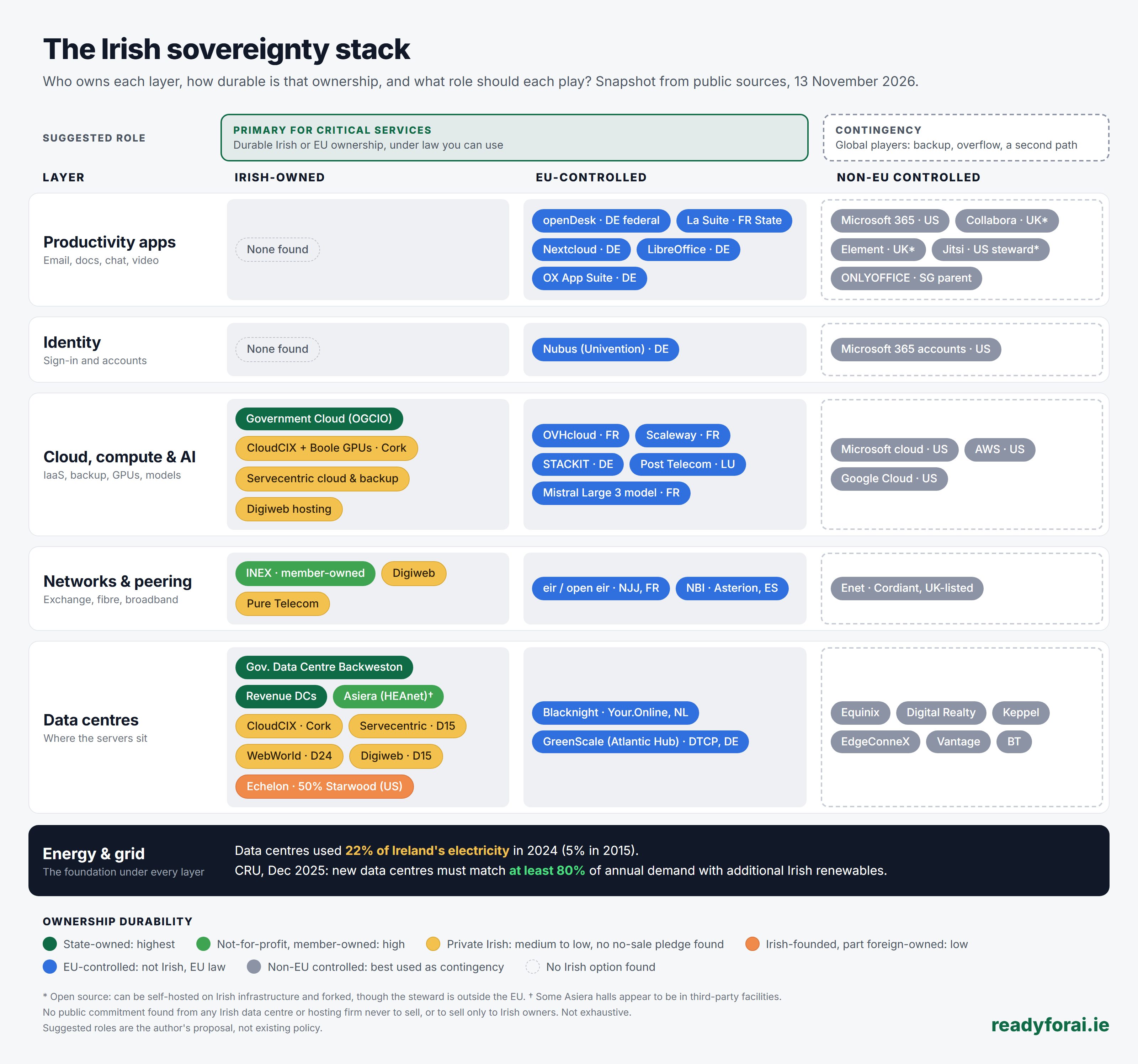
From public sources, the list is short.
State-owned. The Government Data Centre at Backweston, Co Kildare, is a purpose-built, Government owned and run facility, with public bodies migrating through 2026 and into 2027. The OGCIO also runs a private Government Cloud, and the Revenue Commissioners operate two data centres that host services for over 50 other Government bodies.
Not-for-profit and member-owned. Asiera (formerly HEAnet), owned by Irish universities and technological universities, provides hosting, though some of its halls appear to sit in third-party facilities. INEX, the member-owned, not-for-profit internet exchange, keeps Irish internet traffic local.
Privately Irish-owned. CloudCIX and the Cork Internet eXchange in Hollyhill, Cork, a family-owned business that launched the Boole supercomputer (Nvidia B200 GPUs) in January 2026. Servecentric in Blanchardstown, privately Irish owned since 2002. WebWorld, which runs two data centres in Tallaght. Digiweb, headquartered in Dundalk, with a data centre in Blanchardstown.
Now look at what has left. Since 2021:
- Blacknight, Irish-owned since 2003 with a data centre in Carlow, joined Amsterdam-based Your.Online in June 2026.
- LetsHost and Hosting Ireland are now part of team.blue (Belgium), which also absorbed Register365's group.
- Atlantic Hub, the Derry and Donegal data centre developer, came under majority ownership of Germany's DTCP in 2024 and became GreenScale.
- Enet's parent, Speed Fibre Group, has been owned by UK-listed Cordiant Digital Infrastructure since 2023.
- Ergo agreed a sale to US-based Presidio in October 2025, and Datapac went to the UK's Westcoast in 2023.
- Echelon Data Centres, Irish-founded, has been 50% owned by US group Starwood Capital since February 2024, and Bloomberg reported in March 2026 that its owners were weighing a sale of part or all of their stakes.
The national networks underneath are foreign-controlled too: eir is majority owned by France's NJJ, and National Broadband Ireland is majority owned by Spain's Asterion.
The question nobody could answer: will they sell?
I wanted to know whether any Irish data centre or hosting company has a documented commitment never to sell, or to sell only to a fully Irish-owned buyer: a constitution clause, a charter, a public pledge.
I found none in any public source.
The founders are not short of conviction. CloudCIX's Jerry Sweeney said in February: "We should not have to deal with US companies. If we want to ensure sensitive data does not leave the country, we cannot rely solely on the magnificent seven." That is a strong stance, but it is not a binding commitment. Digiweb explored options including a possible sale back in 2016.
The most telling example is Blacknight. In June, Michele Neylon wrote:
"I've never wanted an 'exit'... The idea of building up a business simply to flog it to the highest bidder and watch them strip it for parts never appealed to me."
The same post announced Blacknight joining Your.Online. That is not a criticism; founders face succession and investment realities like everyone else. But it proves the point. Founder intent is not a lock.
The only structural protection we found is in State and not-for-profit structures. Asiera's constitution bars paying profits to members, makes membership non-transferable and sends remaining assets to a similar body if it is wound up. INEX's founding documents carry similar clauses. Even these block profit-taking rather than foreign ownership as such, and neither says "Irish-owned only."
That gives a rough durability ranking: State-owned is strongest, member-owned not-for-profit next, then privately Irish-held firms that are Irish today but one decision away from a sale, then part-foreign and already-foreign operators.
What about Microsoft 365 itself?
There is no Irish-owned office suite, email platform or Teams-style chat product of note, and no Irish-owned identity platform that I could find.
The realistic path is European open-source software running on Irish-owned infrastructure:
- openDesk, from ZenDiS, a company of the German federal government, bundles Nextcloud (files), Collabora (documents), OX App Suite (email and calendar), Element (chat), Jitsi (video) and Nubus (identity).
- La Suite numérique, from the French State, offers Docs, Visio, Tchap chat and webmail, all open source and self-hostable.
- Nextcloud (Germany), LibreOffice (a German foundation) and OX App Suite (Germany) can each be self-hosted on Irish data centres.
One caveat worth stating plainly: several building blocks are stewarded outside the EU. Collabora and Element are UK-headquartered, Jitsi's steward 8x8 is American, and ONLYOFFICE's parent company is in Singapore. The real sovereignty lever is the open-source licence. You can host it yourself, and if a steward changes hands, you can fork it.
For AI, the proof point is already here: CloudCIX's Guiden chatbot runs on the Boole system in Cork using Mistral Large 3, a French model.
The policy picture
The rules are moving, but slowly.
- NIS2 is still not law in Ireland. On 20 October the Minister for Justice told the Dáil the National Cyber Security Bill was "at a very advanced stage."
- Energy is the hard constraint. Data centres used 22% of national electricity in 2024, up from 5% in 2015. Since December 2025, the CRU requires new data centres to match at least 80% of annual demand with additional Irish renewables.
- The EU Data Act has applied cloud-switching rules since September 2025. Switching charges, including egress, are limited to cost until 12 January 2027, and then abolished. Leaving a provider is about to get cheaper.
- The EU Cloud Sovereignty Framework scores providers from SEAL-0 to SEAL-4. The Commission's €180m sovereign cloud tender in April 2026 required at least SEAL-2, with OVHcloud with Post, STACKIT and Scaleway reaching SEAL-3.
Where the global players fit: contingency
None of this means walking away from Microsoft, AWS, Google or Equinix. They bring scale, security engineering and global reach that no Irish operator can match, and they will stay part of the stack. The mistake is making them the only place critical services run.
The better model flips the default. Run what must keep working, and what must stay under Irish law, on Irish- or EU-owned infrastructure with ownership you can rely on. Then contract the global players as contingency providers: backup, overflow capacity and a second path when the primary fails.
That hedge works in both directions. An Irish operator can have a bad week too, or be sold. A global provider on standby covers both risks, and a sovereign primary covers the outage this week showed. The Data Act makes the arrangement cheaper, because moving data between the two is about to stop costing switching charges.
My proposal: make long-term ownership a procurement criterion
This is my proposal, not existing policy. Public bodies, and any organisation serious about resilience, should score suppliers on ownership durability, not just location. That means rewarding structures that lock in Irish or European control: State ownership, member-owned not-for-profits, cooperatives, golden shares or steward-ownership models. Suppliers that want the points should have to write it down.
This does not shut the global players out. It decides which role they compete for. The primary role for critical services goes to suppliers with durable ownership; the contingency role stays open to everyone, and that is where the global providers' scale earns its place.
Right now nothing rewards a binding no-sale promise, so nobody makes one. Change the scoring and some Irish operators would.
A practical checklist for Irish leaders
- Map your stack by layer: energy, data centre, network, cloud and AI, identity, and apps. Note who owns each one and where they are headquartered.
- Ask about ownership, not just location. Who is the ultimate owner? Has it changed in the last five years? Is it under review?
- Ask for it in writing. Request any constitutional or contractual commitment on change of control, and add change-of-control exit rights to your contracts.
- Plan for the outage you just lived through. Keep an email and messaging fallback that does not depend on a single provider's sign-in.
- Give the global players a defined role. Decide which services must run on durable Irish or EU ownership, and contract a global provider as the contingency for them: backup, overflow and a tested second path.
- Pilot an EU open-source suite for one team, hosted on Irish-owned infrastructure.
- Use the Data Act. Diarise 12 January 2027, when switching charges go, and get your data export plan ready before then.
- Get ahead of NIS2. Do not wait for the Bill to pass to understand your supply-chain risk.
Sovereignty is not a flag on a server. It is ownership you can rely on, under law you can use, for longer than the next funding round.
Sources
- RTÉ, Disruption as Microsoft battles to fix global outage, 13 Nov 2026
- OGCIO, Build to Share (Government Data Centre)
- Asiera (HEAnet), Data centre hosting
- Asiera constitution (June 2026)
- INEX Memorandum and Articles (2016)
- Irish Examiner, CloudCIX
- Cork Independent, Boole supercomputer launched in Cork
- Servecentric, About us
- WebWorld, Data centre
- Digiweb (Wikipedia)
- Irish Times, Digiweb to review options including possible sale
- RTÉ, Starwood buys 50% of Echelon Data Centres
- DatacenterDynamics, Starwood considers options for Echelon
- Silicon Republic, Blacknight acquired by Your.Online
- Michele Neylon on LinkedIn
- LetsHost merges with team.blue
- team.blue, Register Group joins
- DTCP invests in Atlantic Hub
- Speed Fibre Group acquisition by Cordiant
- Presidio to acquire Ergo
- Business Plus, Westcoast to acquire Datapac's parent
- Irish Times, NJJ and eir
- NBI governance structure
- openDesk documentation
- La Suite numérique
- Collabora, About us
- ONLYOFFICE ownership disclosure
- Oireachtas, PQ on NIS2 / National Cyber Security Bill, 20 Oct 2026
- RTÉ, 80% of data centre energy must come from renewables (CRU)
- EU Data Act summary
- European Commission, Cloud sovereignty through strategic procurement, 17 Apr 2026