
When Microsoft 365 went down across 74 countries this week, the HSE lost email for hours. So did companies across Ireland. Most of them had done everything they were told to do. Their data was stored in the EU. Their contracts were in order. None of that helped them send an email.
That's the lesson for anyone running a business or sitting on a board.
Where your data is stored matters less than who controls the service, and whether you have a plan B when it stops.
Three questions to ask your team on Monday
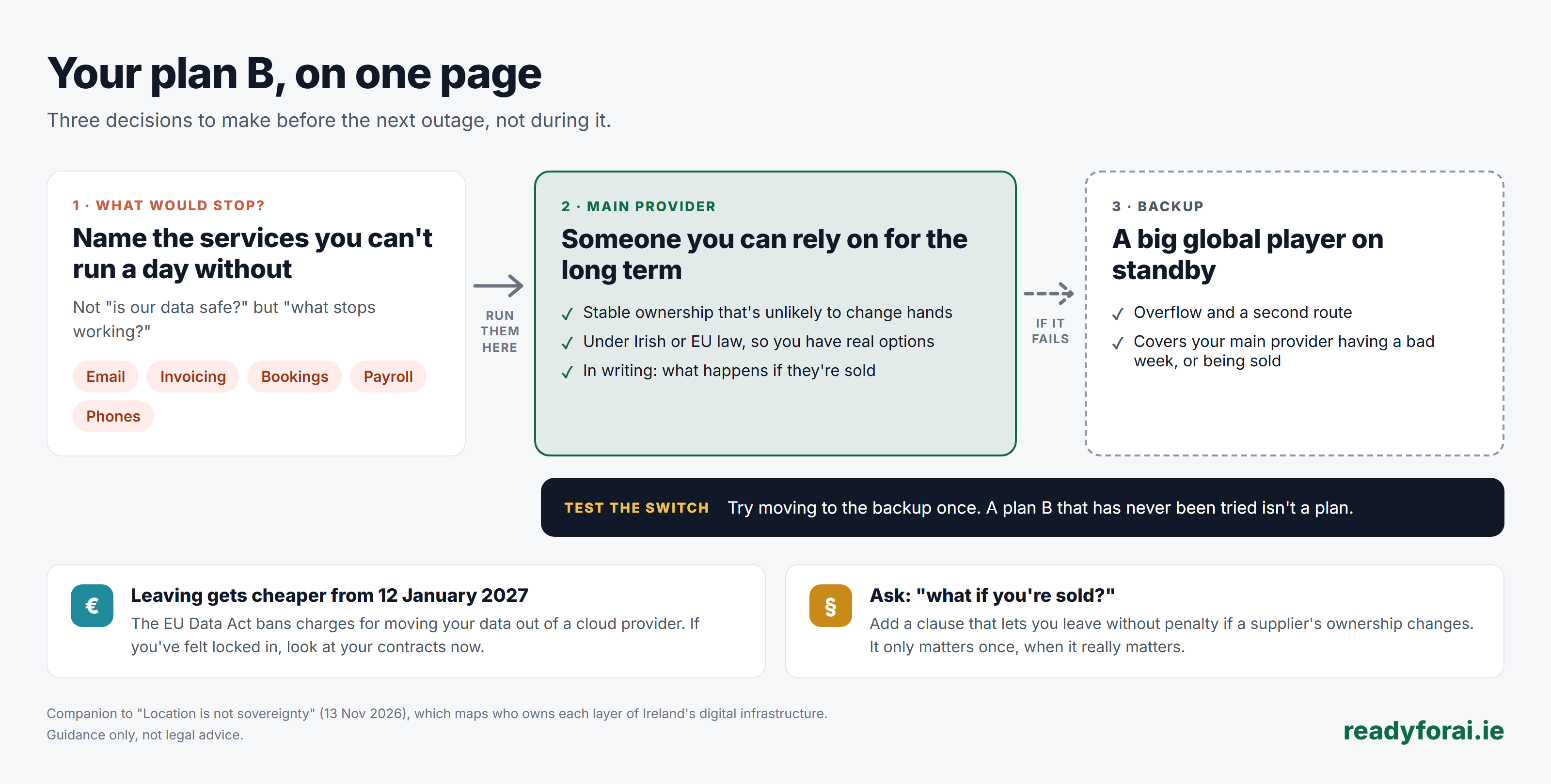
1. If our main provider went down for a day, what would stop?
Not "is our data safe", but what stops working: email, invoicing, bookings, payroll, the phones. Most businesses have never written this list down. Writing it down is the first step, and it costs nothing.
2. Who actually owns the companies we depend on, and could that change?
Irish-owned technology suppliers are fewer than most people think, and the number is shrinking. Since 2021 a run of Irish hosting and network firms have been sold to owners in the Netherlands, Belgium, Germany, the UK and the US. Blacknight, one of the best-known, joined a Dutch group in June. Its founder had written that he never wanted an "exit". Founders change their minds, retire and need investment like everyone else.
I looked for any Irish provider with a written promise never to sell, or to sell only to Irish owners. I found none. A supplier you chose because it was local can belong to someone else next year, on different terms.
3. What is our plan B, and have we tested it?
For most businesses this doesn't mean leaving Microsoft, Google or Amazon. They're good at what they do and they'll stay part of the picture. It means not letting any single provider be the only way your business can operate.
The approach I'd suggest
Think of it the way you think about banking or insurance. You don't keep everything in one place with no fallback.
- Decide what's critical. The handful of services the business can't run without for a day.
- Put those on a provider you can rely on for the long term. That means one whose ownership is stable, and which is under Irish or EU law, so you have real options if something goes wrong.
- Keep the big global players as your backup. They can be your overflow and your second route when the main provider fails. That's a role they're very good at.
- Test the switch once. A plan B that has never been tried isn't a plan.
This works in both directions. A local provider can have a bad week too, or get sold. Having a global player on standby covers that. Having your critical services somewhere stable and close to home covers what happened this week.
Two things that make this cheaper soon
Leaving a provider is about to cost less. Under the EU Data Act, the charges cloud providers can apply when you move your data out are capped at cost now, and banned from 12 January 2027. If you've felt locked in, that changes in January. It's a good moment to look at your contracts.
Your contracts can protect you. Ask suppliers, in writing, what happens if they're sold. Add a clause that lets you leave without penalty if the ownership changes. It's a small ask, and it's the kind of thing that only matters once, when it really matters.
The bigger picture
There's a public policy point too. Right now nothing in public procurement rewards a supplier for promising to stay Irish- or EU-owned, so nobody makes the promise. My proposal is simple: score suppliers on how stable their ownership is, not just where their servers sit. Change what gets rewarded and some suppliers will commit.
The one thing to take away
Resilience isn't an IT setting. It's a business decision about who you depend on, for how long, and what you do on the day they let you down.
The outage this week was a free rehearsal. Use it.
Want the detail? The full version maps who owns each layer of Ireland's digital infrastructure, with sources and an eight-step checklist: Location is not sovereignty.
Guidance only, not legal advice.